


A Conversation with Dr Laura Boudreau

A Conversation with Dr Daniel Gay
A Conversation with Dr Laura Boudreau
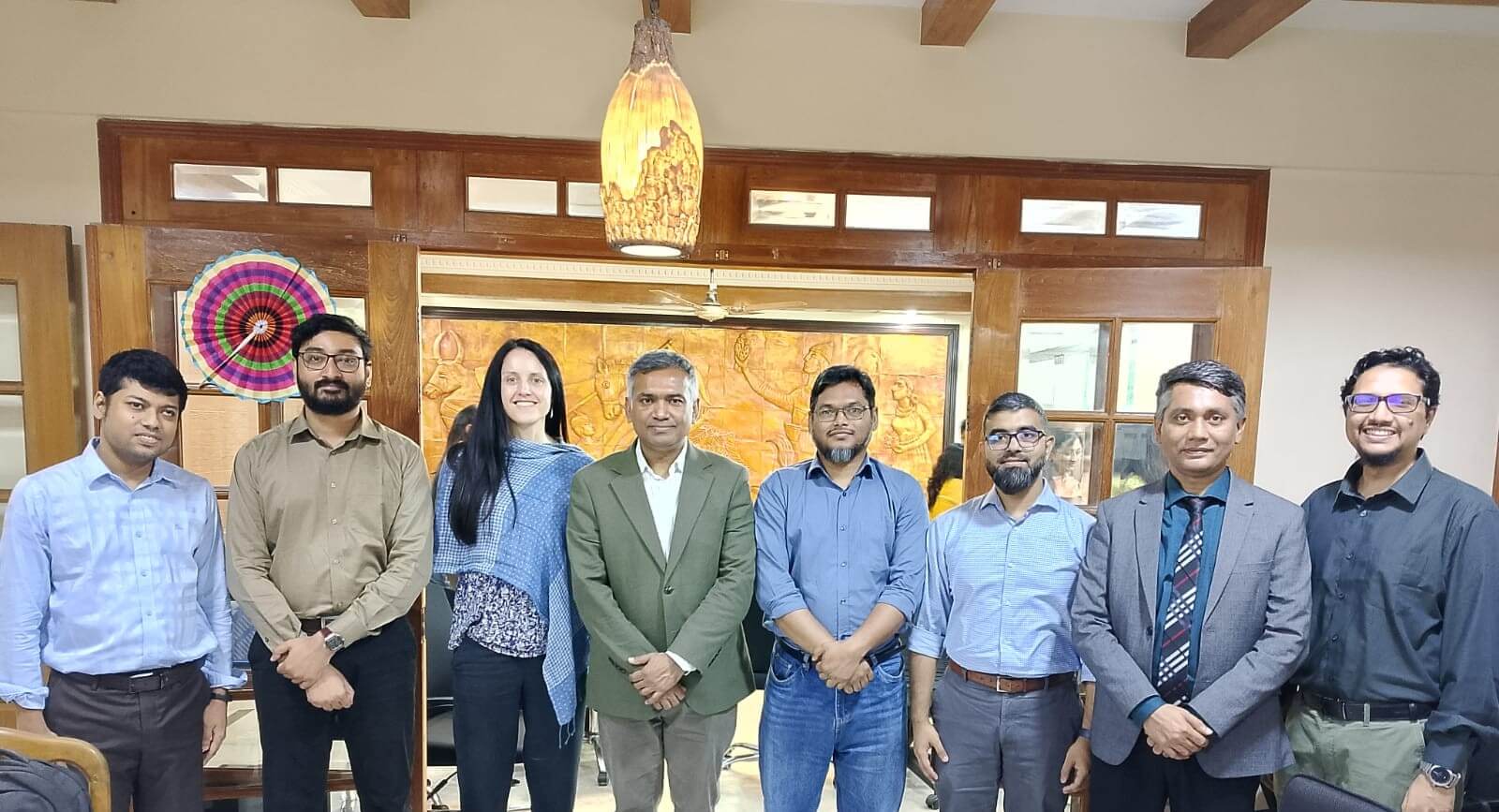
On 14 May 2026, Research and Policy Integration for Development (RAPID) had the pleasure and honour of welcoming Dr Laura Boudreau, a highly distinguished researcher, to its office., This led to an engaging discussion on trade, labour standards, and social protection in developing economies. In introducing Dr Boudreau, RAPID Chairman, Dr Mohammad Abdur Razzaque, regarded her as among rare academic scholar whose work combines rigorous empirical research with deeply policy-relevant questions, particularly on labour issues, global value chains, and workers’ welfare. Reflecting on RAPID’s own work on international trade and social protection, he noted how Dr Boudreau’s research uniquely bridges these fields of academic research and policy relevant analyses that are done at the local level. RAPID Executive Director, Dr M Abu Eusuf, also a professor of development studies at Dhaka University, attended the event to welcome Dr Boudreau.
Dr Boudreau spoke about her long-standing research interest in how integration into global trading systems shapes firms, workers, and labour conditions in lower-income countries. Drawing on more than a decade of engagement with Bangladesh since 2015, she reflected on how the aftermath of the Rana Plaza collapse shaped her research trajectory, particularly her efforts to examine whether multinational buyers’ labour compliance commitments genuinely improve conditions for workers or merely function as corporate rhetoric. She also reflected on the broader challenge of connecting rigorous academic research with policymaking, noting that while evidence-based policymaking has gained greater traction globally, important gaps remain between the pace of academic research and the speed at which policy decisions are made.
During the visit Dr Boudreau presented one of her recent collaborative research papers examining how different types of buyer-supplier relationships shaped the resilience of Bangladesh’s garment sector during the COVID-19 shock. Drawing on customs data, factory-level surveys conducted with the Bangladesh Garment Manufacturers and Exporters Association (BGMEA), and worker-level panel surveys, the study explored whether long-term “relational” trade partnerships between international buyers and Bangladeshi garment manufacturers produced different outcomes compared to more short-term, spot-market transactions. The presentation showed that although both relational and non-relational buyers sharply reduced sourcing volumes during the early months of the pandemic, important differences emerged beneath the surface. Buyers engaged in long-term trading relationships were significantly more likely to maintain ties with suppliers, avoid permanently severing sourcing relationships, and offer concessions such as covering labour and material costs for cancelled or delayed orders. In contrast, more transactional buyers were far more likely to terminate supplier relationships altogether. Dr Boudreau argued that these differences were not immediately visible in customs trade data alone, but became clear when combined with firm- and worker-level survey evidence.
The study further demonstrated that factories connected to relational buyers experienced greater employment stability during the pandemic, while workers employed in those factories reported better outcomes in wages, working hours, savings, workplace safety measures, and job security. Workers in factories linked to long-term buyers were less likely to fear dismissal and more likely to report stronger COVID-related health protections in the workplace. Dr Boudreau argued that these long-term trading relationships effectively acted as an informal insurance mechanism during periods of global disruption, helping distribute risk more evenly across supply chains and cushioning workers from the worst economic effects of the crisis. More broadly, the presentation suggested that many of the most important dimensions of supply-chain resilience and risk-sharing remain hidden within conventional trade data and can only be understood by examining the underlying relationships between firms, suppliers, and workers.
What followed was a thoughtful and wide-ranging discussion on labour standards, global supply chains, evidence-based policymaking, trade-led development, and the relationship between economic growth and workers’ welfare, the highlights of which are presented in the Q&A section below.
Dr Boudreau spoke about her long-standing research interest in how integration into global trading systems shapes firms, workers, and labour conditions in lower-income countries. Drawing on more than a decade of engagement with Bangladesh since 2015, she reflected on how the aftermath of the Rana Plaza collapse shaped her research trajectory, particularly her efforts to examine whether multinational buyers’ labour compliance commitments genuinely improve conditions for workers or merely function as corporate rhetoric. She also reflected on the broader challenge of connecting rigorous academic research with policymaking, noting that while evidence-based policymaking has gained greater traction globally, important gaps remain between the pace of academic research and the speed at which policy decisions are made.
During the visit Dr Boudreau presented one of her recent collaborative research papers examining how different types of buyer-supplier relationships shaped the resilience of Bangladesh’s garment sector during the COVID-19 shock. Drawing on customs data, factory-level surveys conducted with the Bangladesh Garment Manufacturers and Exporters Association (BGMEA), and worker-level panel surveys, the study explored whether long-term “relational” trade partnerships between international buyers and Bangladeshi garment manufacturers produced different outcomes compared to more short-term, spot-market transactions. The presentation showed that although both relational and non-relational buyers sharply reduced sourcing volumes during the early months of the pandemic, important differences emerged beneath the surface. Buyers engaged in long-term trading relationships were significantly more likely to maintain ties with suppliers, avoid permanently severing sourcing relationships, and offer concessions such as covering labour and material costs for cancelled or delayed orders. In contrast, more transactional buyers were far more likely to terminate supplier relationships altogether. Dr Boudreau argued that these differences were not immediately visible in customs trade data alone, but became clear when combined with firm- and worker-level survey evidence.
The study further demonstrated that factories connected to relational buyers experienced greater employment stability during the pandemic, while workers employed in those factories reported better outcomes in wages, working hours, savings, workplace safety measures, and job security. Workers in factories linked to long-term buyers were less likely to fear dismissal and more likely to report stronger COVID-related health protections in the workplace. Dr Boudreau argued that these long-term trading relationships effectively acted as an informal insurance mechanism during periods of global disruption, helping distribute risk more evenly across supply chains and cushioning workers from the worst economic effects of the crisis. More broadly, the presentation suggested that many of the most important dimensions of supply-chain resilience and risk-sharing remain hidden within conventional trade data and can only be understood by examining the underlying relationships between firms, suppliers, and workers.
What followed was a thoughtful and wide-ranging discussion on labour standards, global supply chains, evidence-based policymaking, trade-led development, and the relationship between economic growth and workers’ welfare, the highlights of which are presented in the Q&A section below.
Dr S M Asif Ehsan, Chairman of the department of economics at the North South University, questioned whether the paper’s findings could be fully attributed to pre-existing buyer-supplier relationships, noting that global trade and geopolitical dynamics changed significantly after COVID-19. He asked whether the observed renegotiation behaviour and continued sourcing reflected the causal effect of long-term relational ties alone, or whether broader post-pandemic geopolitical shifts may also have influenced buyers’ decisions.
Dr Laura Boudreau: The study primarily captures buyer behaviour during the immediate COVID-19 period, particularly between 2020 and 2021, rather than the broader geopolitical realignments that became more pronounced later. She acknowledged that while the paper’s central argument is that long-term relational buyers behaved differently because they valued maintaining future trading relationships, the study cannot definitively prove that this mechanism alone explains the observed outcomes. At the same time, she noted that the analysis controls for several alternative buyer characteristics, including buyer size and sourcing strategies, to strengthen the identification of the relationship effect.Dr Boudreau also agreed that global garment markets are far from perfectly competitive and that international buyers often possess substantial bargaining power over suppliers in countries such as Bangladesh. However, she argued that the existence of persistent long-term trading relationships itself suggests the presence of economic rents and negotiated value-sharing within supply chains. Referring to her earlier research on Bangladesh’s garment sector, she noted that suppliers trading with more relational buyers tend to earn higher markups and profits (up to 25 cents), suggesting that although powerful buyers capture a significant share of the gains, they also appear more willing to share risks and rents with suppliers during periods of crisis.
Dr M A Razzaque then asked whether the study was able to identify the characteristics of relational and spot-market buyers, particularly what distinguishes the two groups in practice. He also raised the issue of subcontracting in Bangladesh’s garment sector, questioning how the analysis accounted for the layered relationships between international buyers, primary suppliers, and subcontracting factories, where the nature of buyer-supplier relationships may differ across tiers of the supply chain.
Dr Laura Boudreau: Responding to the question, Dr Boudreau explained that the study only observes direct export transactions recorded in customs data between Bangladeshi exporters and international buyers, meaning subcontracting relationships within Bangladesh remain largely unobservable in the dataset. While acknowledging that subcontracting is an important feature of Bangladesh’s garment sector, she noted that understanding these informal and secondary supply-chain relationships is difficult using administrative trade data alone and may require deeper local research. She added that it remains an open and important question whether subcontractors connected to exporters trading with relational buyers also experienced greater stability during the pandemic.On the characteristics of relational buyers, Dr Boudreau explained that the study classifies buyers based on how concentrated their sourcing relationships are with suppliers over time. Buyers sourcing repeatedly from a smaller set of suppliers are considered more relational, while those spreading orders across many suppliers are treated as more transactional or spot-market oriented. Drawing on examples from the Bangladesh garment sector, she noted that firms such as H&M and Levi Strauss & Co. appeared more relational in their sourcing behaviour, whereas companies such as Walmart and Amazon appeared less relational and more likely to shift suppliers. She also referred to related research showing that Bangladeshi manufacturers trading with relational buyers tend to earn higher profit margins and markups, suggesting that the nature of the buyer itself matters not only for stability during crises but also for value generation and profitability within Bangladesh’s export sector.
Dr Mohammad Maksudur Rahman, Assistant Professor, Department of Economics at the North South University, observed that highly relational buyers may also be systematically different in other ways, particularly in terms of brand reputation, compliance commitments, and concern for fair-trade or ethical sourcing standards. Referring to the pre-pandemic differences visible in the graphs, he suggested that these underlying differences between relational and non-relational buyers might lead the analysis to understate the effect on trade volumes while potentially overstating the effect on cancellations and relationship stability.
Dr Laura Boudreau: Dr Boudreau acknowledged that relational buyers could indeed differ from non-relational buyers along unobservable dimensions, including concerns over reputation and labour standards, and noted that this remains a potential limitation of the analysis. However, she explained that the research team had specifically explored whether relational buyers were systematically more likely to participate in initiatives such as the Accord on Fire and Building Safety in Bangladesh and the Alliance for Bangladesh Worker Safety following the Rana Plaza collapse. Surprisingly, once buyer size was controlled for, the study found no meaningful correlation between relational sourcing behaviour and participation in these compliance initiatives or exposure to activist campaigns related to labour conditions.Dr Boudreau noted that these findings made the research team increasingly confident that the observed differences were more closely tied to the nature of long-term trading relationships themselves rather than simply reputational concerns or ethical branding strategies. Addressing the concern about pre-pandemic differences in the trends, she added that the estimated coefficients and underlying trends appeared relatively stable over time, which strengthened confidence in the interpretation of the results.
Following up on his earlier point, Mohammad Maksudur Rahman argued that the pre-pandemic differences visible in the trend lines could still affect the interpretation of the results, potentially understating the volume effects while overstating the differences in cancellations and relationship stability between relational and non-relational buyers.
Responding to the concern, Laura Boudreau explained that within a difference-in-differences framework, differences in levels before the shock are not necessarily problematic as long as the underlying pre-treatment trends move broadly in parallel. She argued that, in her assessment, the trends appeared sufficiently similar before the pandemic to support the parallel trends assumption, even if some volatility remained in the data. More broadly, she emphasised that the paper’s conclusions do not rely on a single empirical pattern alone, but rather on a broader body of consistent evidence, including supplier survey responses, buyer concessions, and worker-level outcomes, all of which collectively support the interpretation that relational buyers behaved differently during the pandemic and generated more stable outcomes for firms and workers.
Dr Deen Islam observed that firms maintaining long-term relationships with international buyers are likely to be systematically different in terms of reliability, product quality, pricing competitiveness, and potentially political connections. Referring to Bangladesh’s large COVID-era fiscal stimulus programmes, he questioned whether firms linked to relational buyers may also have had greater access to government support, which could partly explain why they were better able to retain workers despite similar levels of order cancellations between relational and non-relational buyers. He then asked how the surveyed firms were selected and whether the sample represented a random cross-section of Bangladesh’s garment exporters. Finally, he raised the possibility that differences in products and buyer types themselves might shape the degree of relational sourcing observed across firms.
Dr Laura Boudreau: Laura Boudreau explained that the research team directly collected information on firms’ access to the COVID fiscal stimulus package and found that uptake was nearly universal, with no meaningful difference between firms exposed to relational buyers and those that were not. In some cases, firms linked to relational buyers appeared to access the stimulus slightly less frequently. She also noted that the analysis incorporates seller fixed effects, allowing comparisons within the same exporting firm across different buyer relationships, which helps control for fixed characteristics such as political connections or firm quality. Regarding the survey methodology, she clarified that the research was conducted in collaboration with the BGMEA using a stratified random sample of member firms. Addressing the concern about product and buyer heterogeneity, Dr Boudreau added that the research team tested the analysis using HS6 product-level and destination-market controls and found that the main customs-based results remained broadly consistent even after accounting for these differences.Jillur Rahman, RAPID Deputy Director and a lecturer in the department of development studies at Dhaka University asked whether the degree of relational contracting varies according to the size of the buyer, questioning whether larger buyers tend to exhibit stronger relational characteristics in global supply chains.
Dr Laura Boudreau: Dr Boudreau explained that buyer size and relationality are indeed positively correlated, which is why the analysis consistently controls for buyer size. She noted that the key comparison in the study is between buyers sourcing similar quantities but differing in how concentrated their supplier relationships are. Dr Boudreau further argued that building long-term relational contracting arrangements requires significant organisational capabilities, including credible communication, coordination, and the ability to maintain relationships even when suppliers face performance challenges. As a result, larger and more productive firms may be better positioned to sustain such relational strategies, making it important to separate the effect of size from the effect of relationality in the empirical analysis.Ishrat Jahan Ishita asked whether similar analyses had been conducted for other major garment-exporting countries such as India or Vietnam, and whether the findings from Bangladesh might also hold across other developing-country supply chains.
Dr Laura Boudreau: In response, Dr Boudreau explained that extending the full analysis to other countries is difficult because the study relies not only on customs trade data, but also on detailed exporter and worker survey data collected during the pandemic. She noted that without those surveys, the research would not have been able to identify how buyer behaviour translated into worker-level outcomes. However, she pointed to related work by her collaborators using customs data from several garment-exporting countries, which found that buyers identified as relational in Bangladesh generally also behaved relationally across other sourcing markets. According to Dr Boudreau, this suggests that relational sourcing may reflect a broader firm-level strategy adopted by international buyers rather than something specific to Bangladesh alone. While she cautioned that the evidence outside Bangladesh remains indirect, she suggested that it is plausible similar patterns may also have existed in other exporting countries during the pandemic.Dr S M Asif Ehsan, commented that relational buyer-supplier arrangements can be understood as a form of stable coalition sustained through repeated interactions. Drawing on a repeated-game framework, he argued that such relationships depend on expectations about future cooperation, and noted that during the early stages of the COVID-19 pandemic many firms may initially have believed that the crisis would permanently disrupt global trade, thereby weakening incentives to maintain long-term relationships. He further observed that the post-pandemic recovery may also have depended on the specific types of products exported by different countries, suggesting that Bangladesh’s experience could differ from countries such as Vietnam because of differences in export composition and post-COVID demand patterns.
Dr Laura Boudreau: Responding to the observation, Dr Boudreau agreed that the early months of the pandemic created enormous uncertainty about the future of global trade and economic activity. However, she noted that garment export volumes recovered relatively quickly, returning close to pre-pandemic levels within roughly six months. She explained that part of this recovery was driven by a surge in global demand for casual and home-oriented apparel during lockdown periods, which benefited Bangladesh’s garment sector despite the severe initial disruption. At the same time, she agreed that the effects of relational sourcing relationships may vary across countries depending on the structure of their export baskets and the types of products in demand during and after the pandemic, acknowledging that this remains an important area for future research.Dr Mahfuz Kabir, Research Director at the Bangladesh Institute of International Strategic Studies (BIISS), questioned whether the paper’s findings could be generalised beyond the exceptional circumstances of the COVID-19 pandemic, noting that the crisis represented a rare global shock. He asked whether similar relational dynamics between buyers and suppliers would also emerge under other forms of disruption, including country-specific trade shocks such as tariff changes in the United States, particularly those associated with the trade policies of Donald Trump.
Dr Laura Boudreau: Dr Boudreau explained that her research team has begun exploring related questions using more recent survey data collected with the Center for Entrepreneurship Development (CED) during the period of uncertainty surrounding U.S. tariff policies in 2025. She noted that the surveys revealed significant renegotiation and cancellation of orders among U.S.-exposed firms even before tariff rates were finalised, suggesting that uncertainty itself can strongly affect buyer behaviour. However, she also acknowledged that the team currently lacks the customs data needed to conduct the same relational-versus-non-relational analysis used in the COVID study.Jahid Ebn Jalal, Deputy Director at RAPID, asked whether the study observed differences in resilience between small and large garment factories during the pandemic, particularly in relation to their exposure to relational buyers. He also questioned whether relational sourcing arrangements were more common among buyers from particular regions, such as the European Union compared to the United States. Finally, he raised a broader policy question about the lack of standard trade and sourcing data, asking what types of reporting mechanisms or responsible sourcing practices could better protect workers and factories during periods of crisis.
Dr Laura Boudreau: Dr Boudreau noted that the research had not yet specifically examined differences between small and large factories, although she conjectured that smaller factories may have experienced more severe negative effects during the pandemic. On regional variation among buyers, she explained that the analysis typically controls for destination markets and buyer headquarters, meaning the key comparisons are often made within countries, such as between different U.S.-based buyers, rather than between the U.S. and Europe as regions. While she acknowledged that the regional dimension is an interesting question worth exploring further, she noted that the current study does not provide a definitive answer.Addressing the broader policy implications, Dr Boudreau argued that the findings suggest trade policy should focus not only on expanding access to export markets, but also on attracting and retaining particular types of buyers that invest in long-term sourcing relationships with local firms. She suggested that relational buyers appear to transfer greater rents and stability into Bangladesh’s economy, benefiting both factory owners and workers through more stable employment and better labour outcomes. From that perspective, she argued that encouraging more responsible and relationship-based sourcing practices among international buyers could strengthen supply-chain resilience and improve the distribution of gains from trade during future economic shocks.
Syful Islam questioned whether maintaining long-term relational ties with buyers may itself require factories to be more compliant or capable of delivering higher-quality products. He asked whether the stronger outcomes observed among relational suppliers could partly reflect the fact that these firms are already better-performing or more compliant factories, enabling them to sustain relationships with international buyers over time.
Dr Laura Boudreau: Dr Boudreau explained that their research compares the same seller producing the same product in the same year across different buyers, showing that suppliers earn higher markups when selling to relational buyers. She noted that most Bangladeshi exporters simultaneously trade with both relational and non-relational buyers, meaning the observed differences cannot be explained solely by certain factories being inherently better or more compliant than others. At the same time, she acknowledged that the findings are consistent with the possibility that relational buyers may partly compensate suppliers for maintaining better workplace standards or stronger compliance practices. Referring to the evidence on stronger COVID safety measures and better worker outcomes in factories linked to relational buyers, she suggested that the higher profits associated with relational trade relationships may help firms absorb some of the costs associated with improved labour standards and workplace protections.Taking part in the conversation, Dr M. A. Razzaque suggested that relational buyers may maintain long-term ties with Bangladeshi suppliers partly because these relationships remain highly profitable for them within the broader structure of global value chains. Referring to Bangladesh’s relatively low quality-adjusted export prices compared to competing countries, he argued that relational buyers may effectively be protecting highly advantageous sourcing arrangements rather than acting out of purely altruistic motives.
Dr Laura Boudreau: Dr Boudreau agreed that relational sourcing arrangements still operate within a broader system characterised by monopsony power and rent extraction. She noted that powerful international buyers retain substantial influence over prices and sourcing decisions and are likely capturing a significant share of the rents generated within global supply chains. At the same time, she argued that the evidence suggests relational buyers share relatively more of those rents with suppliers and workers compared to more transactional buyers, resulting in better outcomes for firms and labour even within an unequal bargaining structure. Dr Boudreau emphasised that these findings should not be interpreted as suggesting an absence of exploitation, particularly in labour markets, but rather that workers and exporters linked to relational buyers appear to fare meaningfully better relative to those connected to more spot-market-oriented buyers.Concluding the session, Dr Razzaque thanked Dr Boudreau for what he described as an exceptionally insightful and intellectually stimulating presentation and discussion.