
Developing a Roadmap for the National Social Insurance Scheme (NSIS) in Bangladesh

৯০ দিন পর কী হবে? ট্রাম্পের শুল্ক নিয়ে র্যাপিড চেয়ারম্যান ড. আব্দুর রাজ্জাকের বিশ্লেষণ-
Final Review of the National Social Security Strategy (NSSS) and Action Plan Phase II (2021–2026)
Contents
About the project
Partner: United Nations Development Programme (UNDP), Department of Foreign Affairs and Trade (DFAT), Government of AustraliaProject duration: August 2025 – February 2026 .
The National Social Security Strategy (NSSS) is the Government of Bangladesh’s flagship framework for reforming the country’s social protection system, first introduced in 2015. It aims to transition from fragmented safety nets to a coordinated, lifecycle-based, and inclusive social protection system. The Action Plan Phase II (2021–2026) builds on the progress of the first phase by deepening reforms in governance, expanding coverage, strengthening delivery systems such as the Single Registry MIS, improving the Grievance Redress System (GRS), and enhancing monitoring and evaluation frameworks. This final review, supported by UNDP with DFAT funding, will assess progress, challenges, and opportunities in implementing the NSSS and Action Plan Phase II. The review will answer eleven KEQs covering achievements, governance effectiveness, inclusion outcomes, and lessons learned to inform the design of the next-generation National Social Protection Strategy (NSPS) 2026+. The project will combine a detailed literature and policy review, quantitative analysis of programme coverage and expenditure trends, and qualitative consultations with government, development partners, and beneficiaries. The findings will be presented to the Cabinet Division, the Central Management Committee for Social Protection, and at the Bangladesh Social Security Conference 2026.
Scope of Work Summary for NSSS Phase II Final Review:
- Implementation Review: Assess progress against NSSS goals and Action Plan Phase II targets, including policy reforms, operational improvements, and institutional arrangements.
- Governance and Coordination Analysis: Examine the roles and effectiveness of coordination mechanisms, including the Central Management Committee (CMC) and sub-committees.
- Inclusion Assessment: Evaluate the integration of gender, disability inclusion, and LNOB principles across social protection programmes.
- Political Economy Analysis: Understand fiscal constraints, policy coherence, and institutional incentives shaping NSSS implementation.
- Forward-looking Recommendations: Develop evidence-based recommendations to strengthen the future social protection strategy for Bangladesh.
Project activities
Technical meeting with UNDP Bangladesh: Final Review of the National Social Security Strategy (NSSS) and Action Plan Phase II (2021-26)
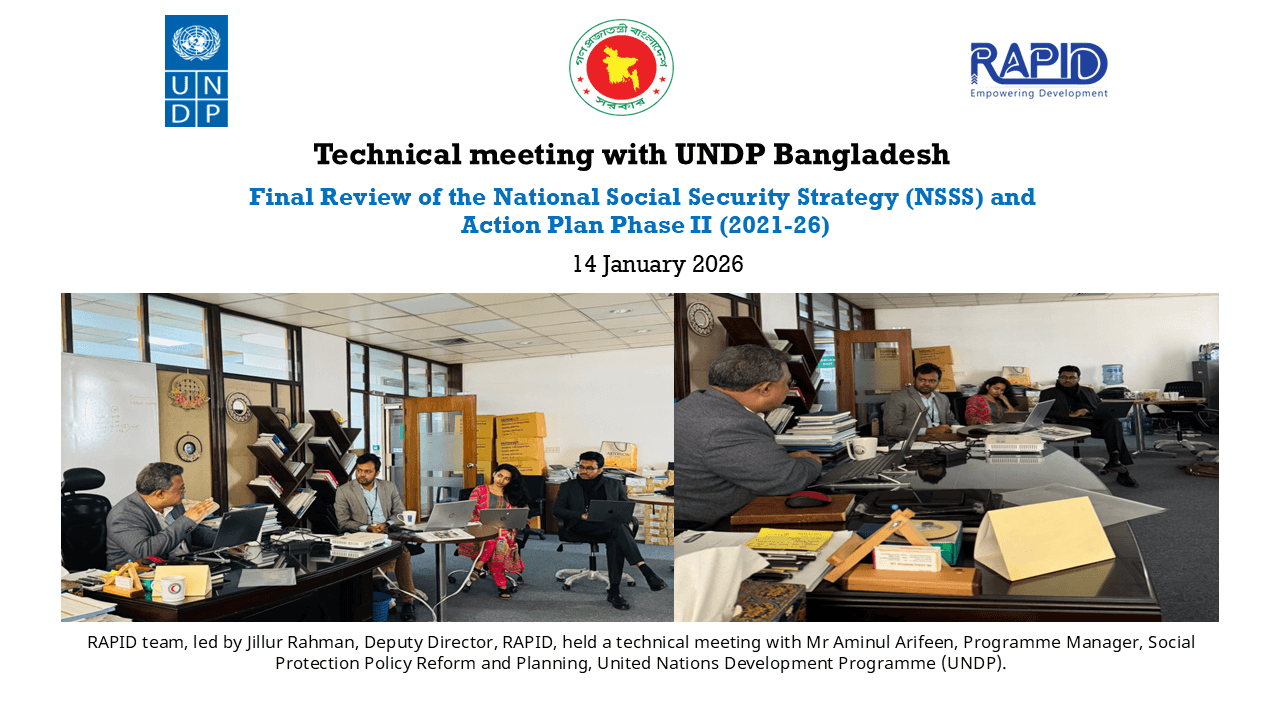
On 14 January 2026, the RAPID team, led by Jillur Rahman, Deputy Director, RAPID, held a technical meeting with Mr. Aminul Arifeen, Programme Manager, Social Protection Policy Reform and Planning, United Nations Development Programme (UNDP), to discuss the scoring analysis for the final review of the National Social Security Strategy (NSSS).”
The session allowed the team to review the proposed scoring approach in a structured manner, covering the assessment criteria, the basis for justification, and the arrangements for maintaining consistency across themes and data sources. It also helped clarify expectations around interpretation and documentation, so that the scoring outputs remain transparent, comparable, and aligned with the overall assessment framework. This meeting was a part of a wider series of engagement sessions with UNDP that will be convened periodically as the review progresses, ensuring that emerging findings are validated, analytical choices remain well-grounded, and the report is strengthened through iterative technical inputs.
Inception Workshop: Final Review of the National Social Security Strategy (NSSS) and Action Plan Phase II (2021-26)
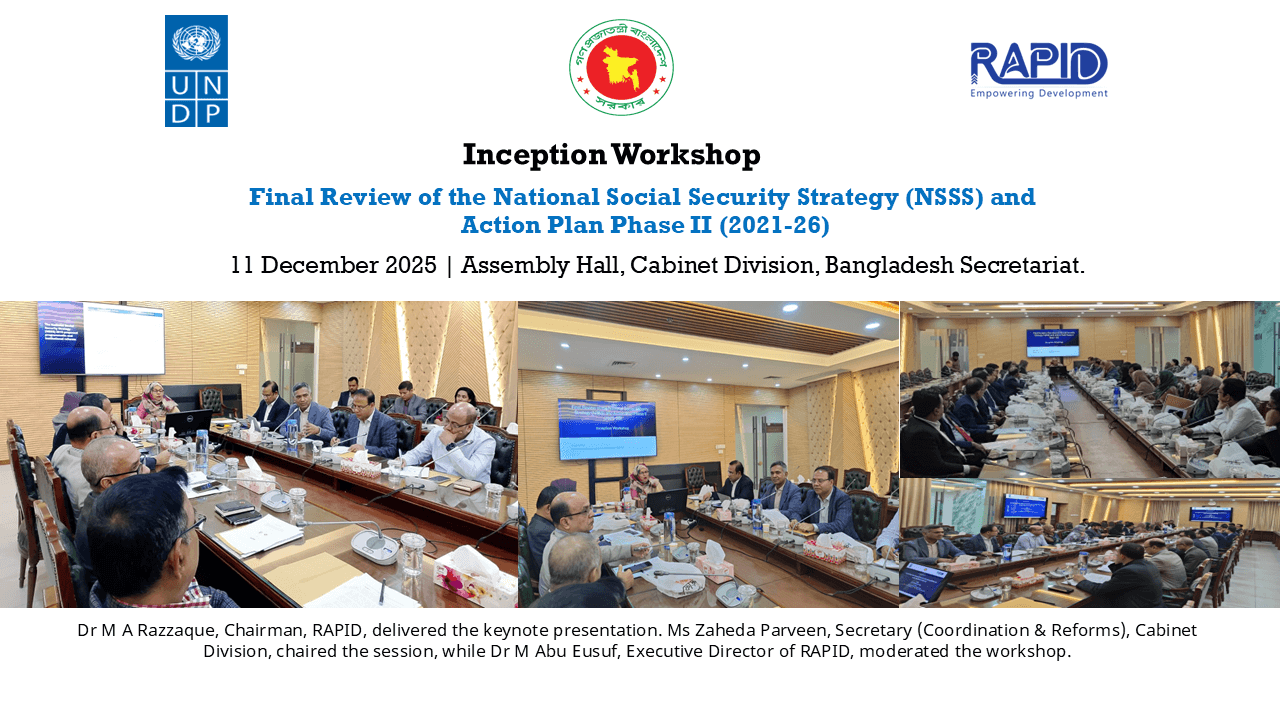
On 11 December 2025, Research and Policy Integration for Development (RAPID) and Cabinet Division, jointly organised a Workshop. Mr Mohammad Khaled Hasan, Additional Secretary (Coordination), Cabinet Division, delivered the welcome and closing remarks. Ms Zaheda Parveen, Secretary (Coordination & Reforms), Cabinet Division, chaired the session, while Dr M Abu Eusuf, Executive Director of RAPID, moderated the workshop. Dr M A Razzaque, Chairman, RAPID, delivered the keynote presentation.
Focus Group Discussion (FGD): Final Review of the National Social Security Strategy (NSSS) and Action Plan Phase II (2021-26)
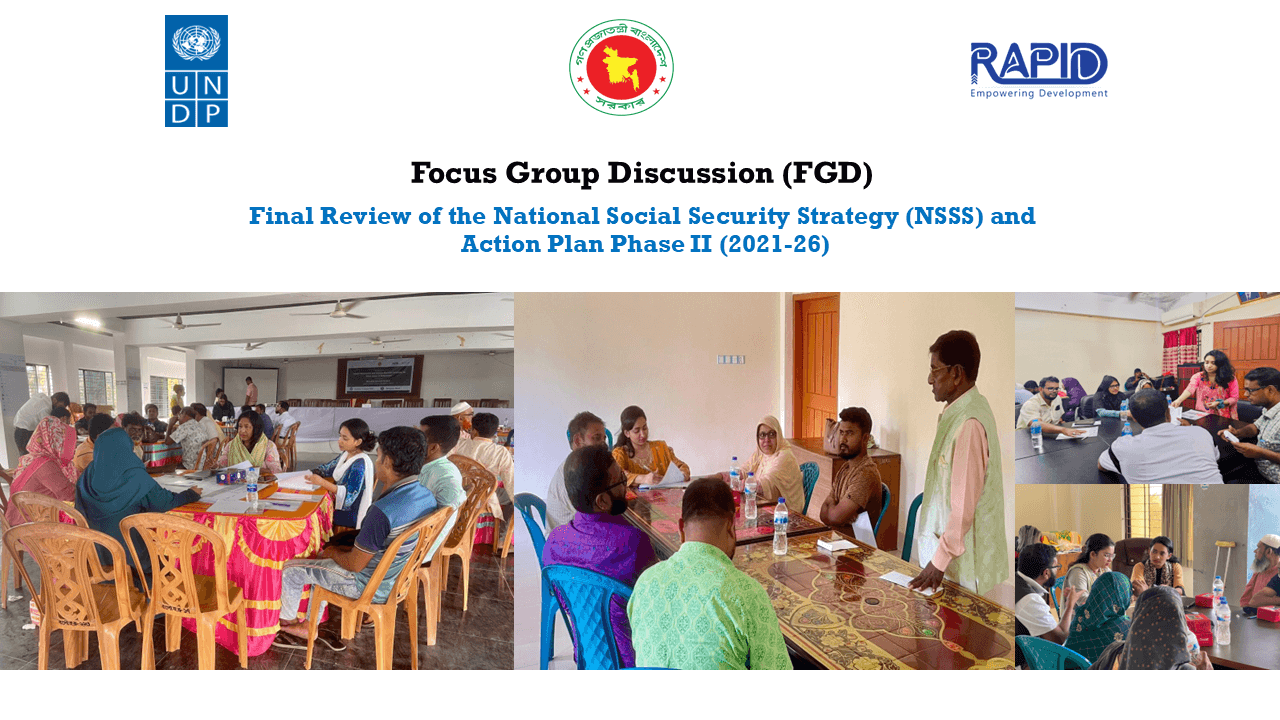
As part of the NSSS review work, six focus group discussions were conducted in November and December across three upazilas, Shahrasti (Chandpur), Bakshiganj (Jamalpur), and Derai (Sunamganj), engaging social protection beneficiaries alongside other locally relevant stakeholders. These discussions were used to document how programmes were experienced in practice, including how people learned about entitlements, whether eligibility and selection processes were understood as fair, and how payment and service delivery arrangements were navigated at the local level. Participant also shared lived realities on adequacy and predictability of support, practical barriers faced by older persons, women, and low-income households, and the extent to which grievance and feedback channels were known, trusted, and used. The combined evidence from the three sites provided a structured basis for triangulating beneficiary experience with administrative and policy review findings, particularly where implementation realities differed across locations and programme types.