

Research Report: Between 2010 and 2024, while the average annual GDP growth rate stood at over 6.0 per cent, employment growth lagged significantly behind, averaging only 2.2 per cent.

RAPID Monthly Newsletter || April 2026
About the project
Partner: Export Competitiveness for Jobs (EC4J) Project, Ministry of Commerce, Government of the People’s Republic of BangladeshProject duration: March-August 2026
Bangladesh’s economic growth over the past decades has been largely driven by its export-oriented private sector, particularly the ready-made garments (RMG) industry. However, as the country prepares to graduate from Least Developed Country (LDC) status in November 2026, it faces a critical transition. Graduation will lead to the gradual loss of preferential market access, including Duty-Free Quota-Free (DFQF) benefits, which currently cover a significant share of Bangladesh’s exports. This poses substantial risks to export competitiveness, especially in key markets such as the European Union, Canada, and Japan. The country’s export base remains highly concentrated, with the RMG sector accounting for the vast majority of total exports. This concentration makes the economy vulnerable to external shocks and changes in global trade regimes. In this context, there is a growing policy priority to identify and develop new and emerging private sectors that can support export diversification, enhance value addition, and generate sustainable employment opportunities. This project aims to conduct a comprehensive competitiveness study of potential private sectors in Bangladesh. It seeks to identify high-potential sectors that can drive future export growth in the post-LDC context, while also assessing the likely impacts of losing trade preferences. The study will involve detailed sectoral analysis, value chain assessments, and stakeholder consultations to understand constraints, opportunities, and required policy interventions. In addition, the project will examine trade policy options, including prospects for securing alternative preferential arrangements such as GSP+ and exploring Free Trade Agreements (FTAs). It will also assess gaps in trade facilitation, standards compliance, skills development, and the investment climate that may affect sectoral competitiveness. A key outcome of the assignment will be the development of a feasibility study and a detailed Development Project Proposal (DPP), outlining strategic interventions, investment priorities, and implementation mechanisms. The findings are expected to support the Government of Bangladesh in formulating evidence-based policies and building a more diversified, resilient, and competitive export economy in the post-LDC era.
Objectives of the Study:
- Assess and Propose Strategies for Export Competitiveness: Conduct a detailed quantitative and qualitative assessment of the likely erosion of export competitiveness post-LDC graduation and propose a set of policy and enterprise-level interventions to offset this impact.
- Develop an Export Diversification Roadmap: Identify and analyze high-potential sectors and formulate a targeted roadmap to enhance export diversification in terms of both products and markets.
- Identify and Address Capacity Building Needs: Pinpoint the critical public and private sector capacity gaps—particularly in trade facilitation, standards compliance, and skills—required to achieve and sustain competitiveness in a non-preferential trading regime.
- Feasibility Study: Feasibility Study for the 4+ potential private sectors in Bangladesh, which will be finalized from the sector study report.
- DPP Preparation: Preparation of a Development Project Proposal (DPP) with detailed cost estimates for the selected sectors.
Project activities
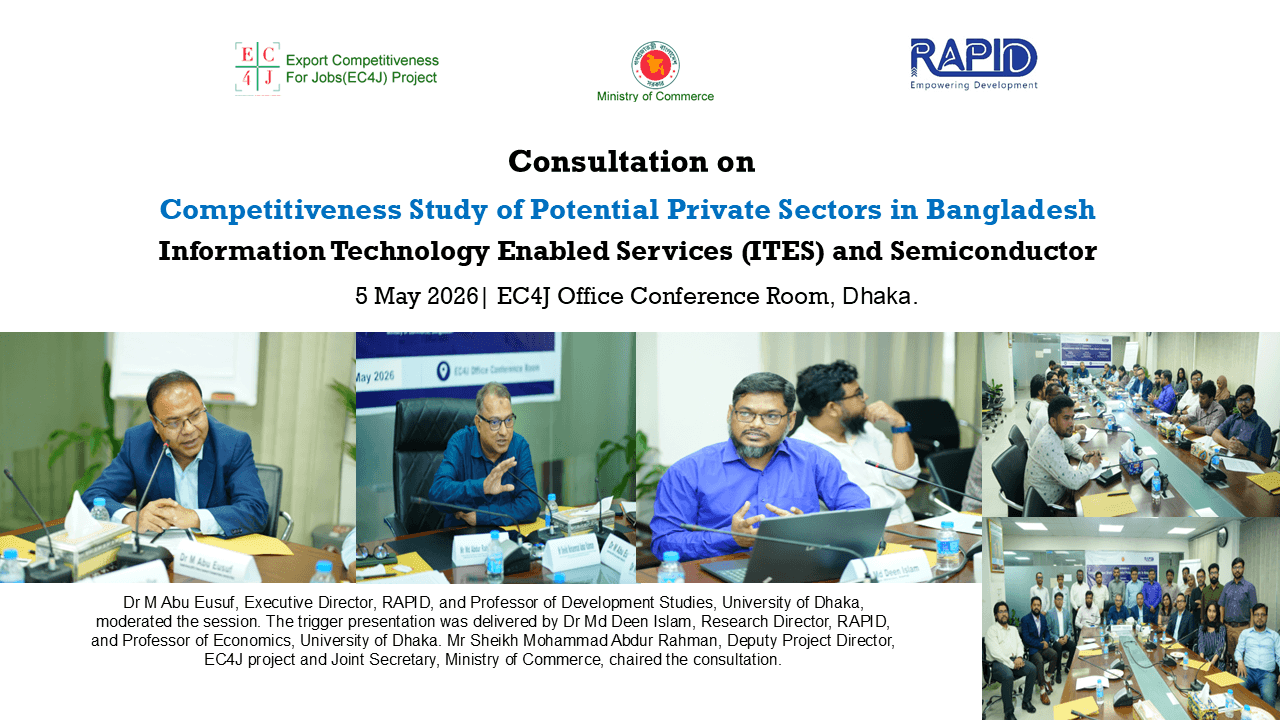
Consultation: Competitiveness Study of Potential Private Sectors in Bangladesh-Information Technology Enabled Services (ITES) and Semiconductor
On 5 May 2026, Research and Policy Integration for Development (RAPID), in collaboration with the Export Competitiveness for Jobs (EC4J) Project of the Ministry of Commerce, organised a consultation on “Competitiveness Study of Potential Private Sectors in Bangladesh”.
The consultation focused on the Information Technology Enabled Services (ITES) and Semiconductor, aiming to better understand its evolving needs, key challenges, and priority areas for enhancing competitiveness and export readiness.
The session was attended by representatives from key industry associations, along with private sector actors, government stakeholders, and members from academia, ensuring a comprehensive and inclusive discussion.
Dr M Abu Eusuf, Executive Director, RAPID, and Professor of Development Studies, University of Dhaka, moderated the session. The trigger presentation was delivered by Dr Md Deen Islam, Research Director, RAPID, and Professor of Economics, University of Dhaka. Mr Sheikh Mohammad Abdur Rahman, Deputy Project Director, EC4J project and Joint Secretary, Ministry of Commerce, chaired the consultation.
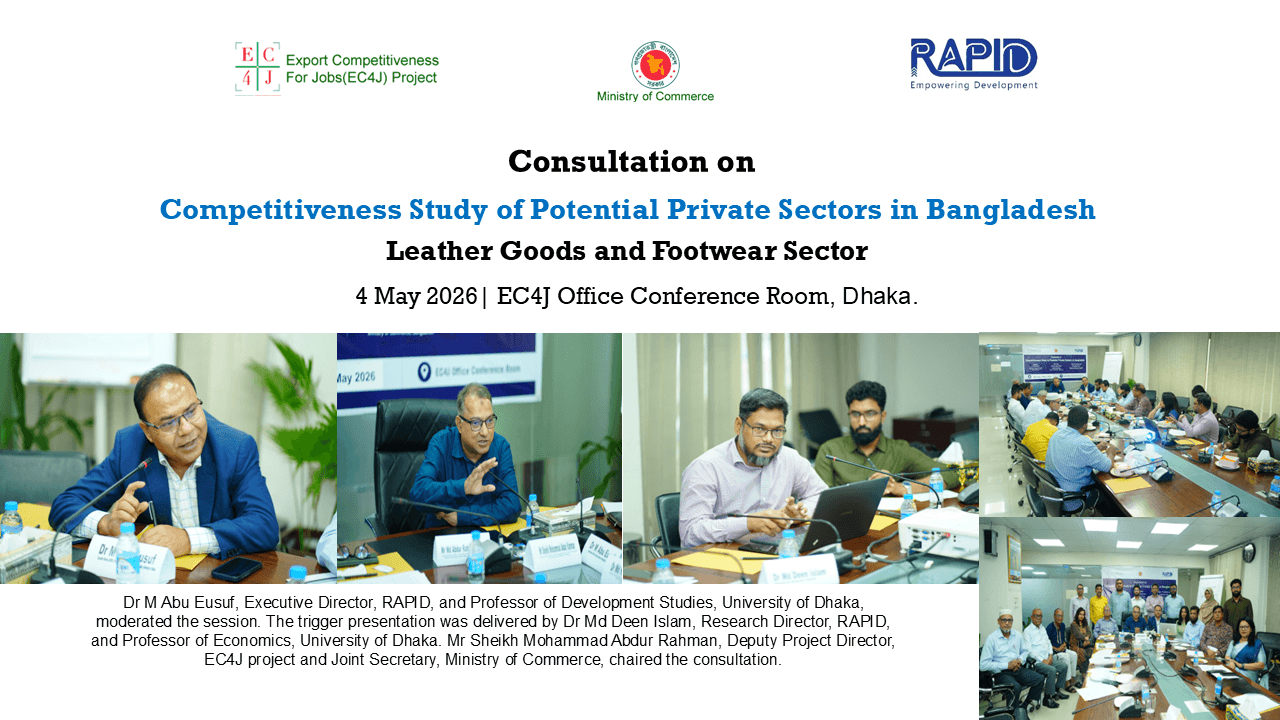
Consultation: Competitiveness Study of Potential Private Sectors in Bangladesh-Leather Goods and Footwear Sector
On 4 May 2026, Research and Policy Integration for Development (RAPID), in collaboration with the Export Competitiveness for Jobs (EC4J) Project of the Ministry of Commerce, organised a consultation on “Competitiveness Study of Potential Private Sectors in Bangladesh”.
The consultation focused on the Leather Goods and Footwear Sector, aiming to better understand its evolving needs, key challenges, and priority areas for enhancing competitiveness and export readiness.
The session was attended by representatives from key industry associations, along with private sector actors, government stakeholders, and members from academia, ensuring a comprehensive and inclusive discussion.
Dr M Abu Eusuf, Executive Director, RAPID, and Professor of Development Studies, University of Dhaka, moderated the session. The trigger presentation was delivered by Dr Md Deen Islam, Research Director, RAPID, and Professor of Economics, University of Dhaka. Mr Sheikh Mohammad Abdur Rahman, Deputy Project Director, EC4J project and Joint Secretary, Ministry of Commerce, chaired the consultation.
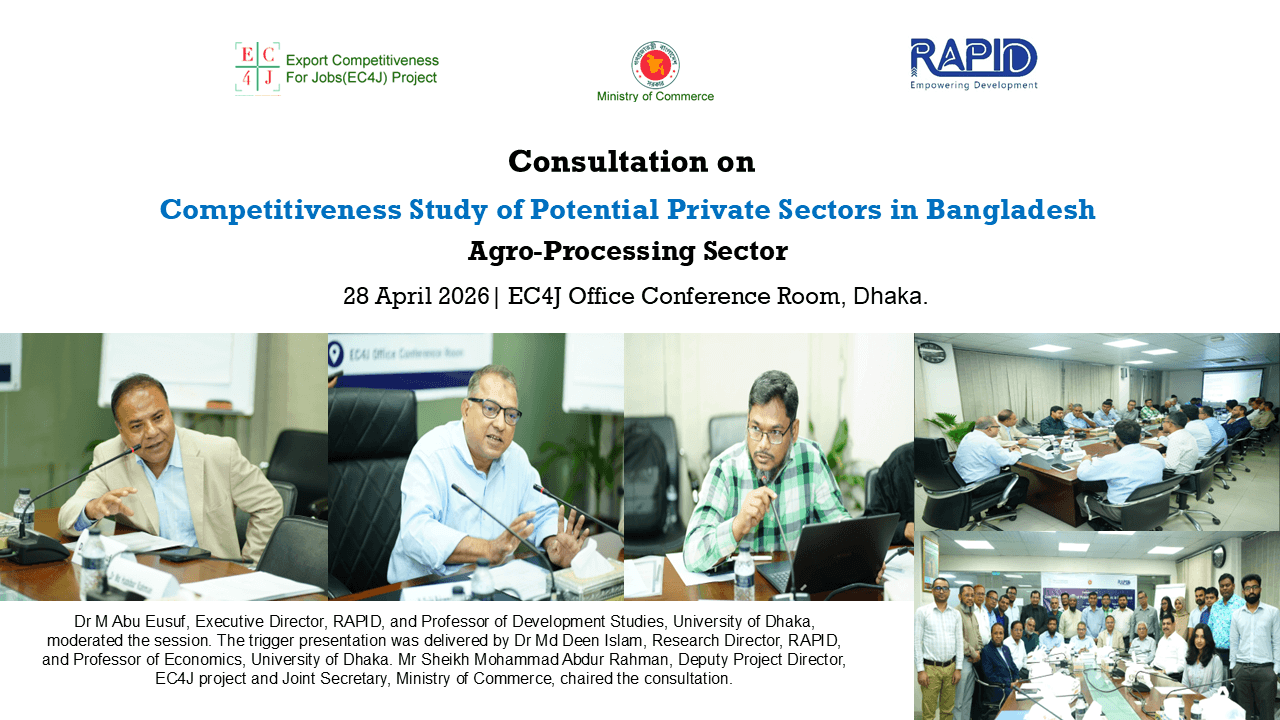
Consultation: Competitiveness Study of Potential Private Sectors in Bangladesh-Agro-Processing Sector
On 28 April 2026 , Research and Policy Integration for Development (RAPID), in collaboration with the Export Competitiveness for Jobs (EC4J) Project of the Ministry of Commerce, organised a consultation on “Competitiveness Study of Potential Private Sectors in Bangladesh”.
The consultation focused on the agro-processing sector, aiming to better understand its evolving needs, key challenges, and priority areas for enhancing competitiveness and export readiness.
The session was attended by representatives from key industry associations, along with private sector actors, government stakeholders, and members from academia, ensuring a comprehensive and inclusive discussion.
Dr M Abu Eusuf, Executive Director, RAPID, and Professor of Development Studies, University of Dhaka, moderated the session. The trigger presentation was delivered by Dr Md Deen Islam, Research Director, RAPID, and Professor of Economics, University of Dhaka. Mr Sheikh Mohammad Abdur Rahman, Deputy Project Director, EC4J project and Joint Secretary, Ministry of Commerce, chaired the consultation.
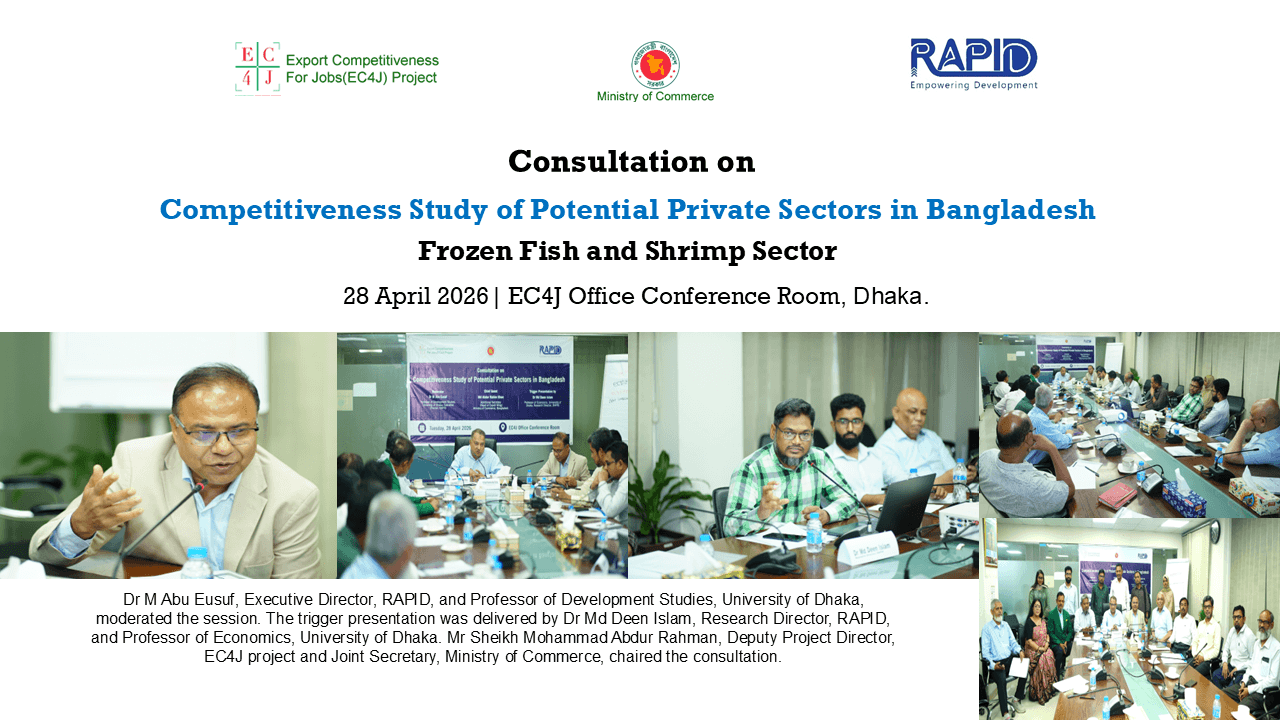
Consultation: Competitiveness Study of Potential Private Sectors in Bangladesh-Frozen Fish and Shrimp Sector
On 28 April 2026 , Research and Policy Integration for Development (RAPID), in collaboration with the Export Competitiveness for Jobs (EC4J) Project of the Ministry of Commerce, organised a consultation on “Competitiveness Study of Potential Private Sectors in Bangladesh”.
The consultation focused on the frozen fish and shrimp sector, aiming to better understand its evolving needs, key challenges, and priority areas for enhancing competitiveness and export readiness.
The session was attended by representatives from key industry associations, along with private sector actors, government stakeholders, and members from academia, ensuring a comprehensive and inclusive discussion.
Dr M Abu Eusuf, Executive Director, RAPID, and Professor of Development Studies, University of Dhaka, moderated the session. The trigger presentation was delivered by Dr Md Deen Islam, Research Director, RAPID, and Professor of Economics, University of Dhaka. Mr Sheikh Mohammad Abdur Rahman, Deputy Project Director, EC4J project and Joint Secretary, Ministry of Commerce, chaired the consultation.