
Developing a Roadmap for the National Social Insurance Scheme (NSIS) in Bangladesh_F

Development Letters
Beyond Jobless Growth: Rethinking Youth Employment in Bangladesh through a Post-Neoliberal Lens
Contents
About the project
Partner: The Friedrich-Ebert-Stiftung (FES)Project duration: July 2025 – November 2025
This study, “Beyond Jobless Growth: Rethinking Youth Employment in Bangladesh through a Post-Neoliberal Lens”, will focus on the evolving dynamics of youth employment in Bangladesh. Despite sustained GDP growth and economic diversification, young people face increasing barriers to quality employment marked by informality, skills deficits, underemployment, and gender disparities. The study will critically examine the limitations of conventional neoliberal strategies and propose a post-neoliberal framework that emphasises inclusive growth, decent work, and sustainability. Using a mixed-methods approach, combining a systematic review of literature and policy documents with descriptive analysis of Labour Force Survey data, it will investigate structural impediments, policy gaps, and sectoral employment patterns. By focusing on sectors such as agriculture, manufacturing, services, care economy, green jobs, and digital work, the study aims to inform coherent, forward-looking employment policies. It will contribute to national policy discourse at a time when Bangladesh stands at a critical juncture in its demographic transition, seeking to unlock the potential of its youth for a fairer and more resilient future.
Objectives of the Study:
- Identify structural and institutional barriers to quality youth employment in Bangladesh.
- Analyse policy gaps and sectoral trends affecting youth employment outcomes.
- Examine youth employment through a post-neoliberal lens promoting inclusivity and decent work.
- Propose alternative job creation strategies based on state-led, equitable development.
- Provide evidence to inform forward-looking and coherent employment policies.
- Support dialogue among stakeholders to enhance policy responses for youth employment.
Project activities
Dissemination Event: Beyond Jobless Growth: Towards an Employment-Centred Policy Framework for Bangladesh through a Post-Neoliberal Lens
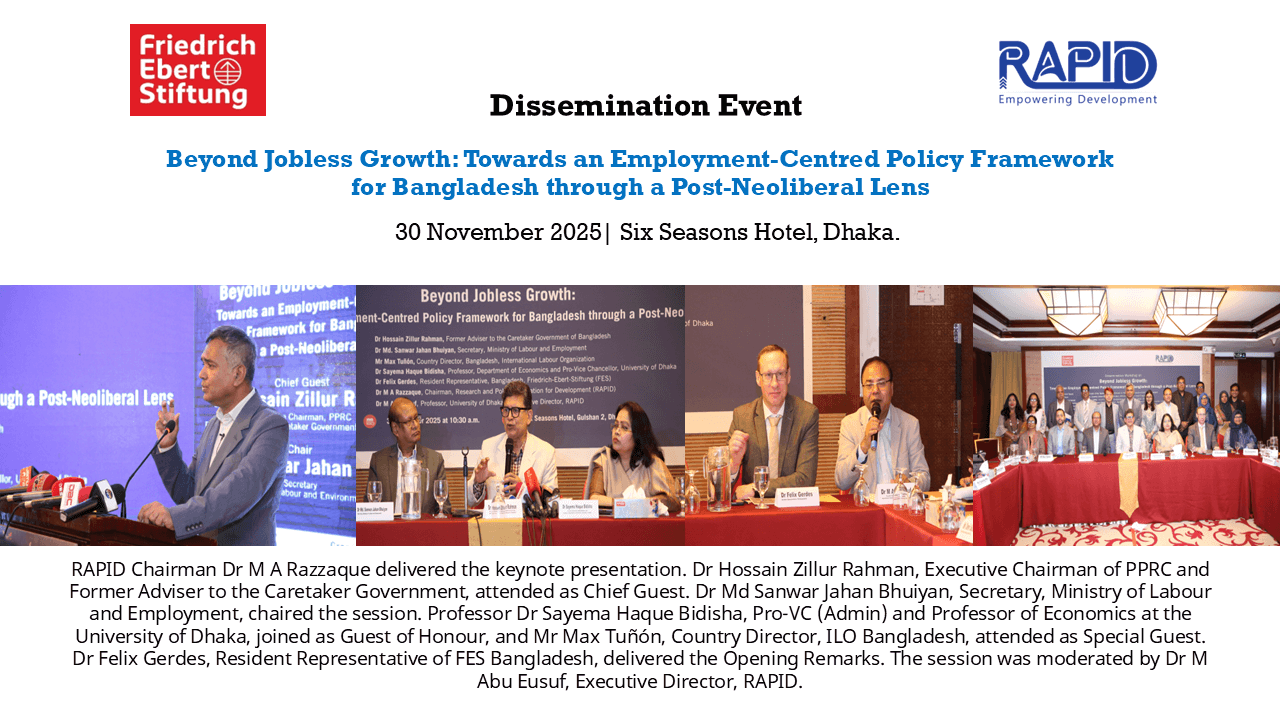
On 30 November 2025, Research and Policy Integration for Development (RAPID) and Friedrich-Ebert-Stiftung Bangladesh, organised a dissemination event titled “Beyond Jobless Growth: Towards an Employment-Centred Policy Framework for Bangladesh through a Post-Neoliberal Lens” to discuss how Bangladesh’s jobless growth can be addressed by developing an employment-centred policy framework that, drawing on post-neoliberal thinking, reorients policy options towards decent work and inclusive structural transformation.
The event was graced by the presence of Dr Hossain Zillur Rahman, Executive Chairman of PPRC and Former Adviser to the Caretaker Government, as the Chief Guest.
Dr Md Sanwar Jahan Bhuiyan, Secretary, Ministry of Labour and Employment, attended as the Chair.
Professor Dr Sayema Haque Bidisha, Pro-VC (Admin) and Professor of Economics at the University of Dhaka, joined as the Guest of Honour.
Mr Max Tuñón, Country Director, ILO Bangladesh, joined as the Special Guest.
Dr Felix Gerdes, Resident Representative of FES Bangladesh, delivered the Opening Remarks, followed by the keynote presentation from Dr M. A. Razzaque, Chairman of RAPID.
The session was moderated by Dr M. Abu Eusuf, Executive Director of RAPID and Professor at the University of Dhaka.
The esteemed panellists included Mr Sultan Uddin Ahmed, Executive Director, BILS; Mr A.K.M. Fahim Mashroor, CEO, Bdjobs.com; Ms Farzana Khan, Deputy Managing Director, SME Foundation; Ms Taslima Miji, Managing Director, Leatherina; Ms Kohinoor Yeasmin, CEO, TARANGO; and Ms Tanvir Sultana, Deputy General Manager, PKSF.
A key recommendation of Dr Razzaque’s presentation is that the upcoming Ninth Five-Year Plan should be designed explicitly as an employment-centred development strategy, backed by adequate fiscal resources, strong inter-ministerial coordination, and significantly strengthened state capability to implement coherent, capability-building reforms.
He also called for strategic industrial and trade policies that support diversification, harness digitalisation and green industrialisation for inclusive job creation, and scale up investment in human capital, skills, and the care economy, with gender-responsive and climate-resilient employment at the core.
As Chief Guest, Dr Hossain Zillur Rahman stressed that Bangladesh needs a new employment-centred, equity-focused growth strategy supported by stronger governance, deeper human capital reforms, and a clearer understanding of labour market trends—especially for women.
Dr Sayema Haque Bidisha, Guest of Honour, noted that employment growth depends on productivity, inclusive workforce participation, and better alignment of skills with private-sector needs. Targeted incentives, rural investment, and support for worker rights and freelancing can reduce youth unemployment and strengthen the labour market.
Mr Max Tuñón, Special Guest and ILO Country Director, highlighted the need to shift toward labour-focused policies—especially for youth and women—by strengthening labour rights, integrating regional employment strategies, improving childcare guidelines, and boosting productivity in key sectors to create better-quality jobs.