

Working Paper || April 2026 || RCEP accession should be treated as both a market access opportunity and a reform strategy, with careful sequencing.

RAPID Monthly Newsletter || September 2026
An Integrated Study to Achieve the Goals and Objectives of National Tariff Policy 2023 of Bangladesh
Contents
About the project
Partner: Bangladesh Regional Connectivity Project-1 (BRCP-1), Ministry of CommerceProject duration: 4 months
The Government of the People’s Republic of Bangladesh is implementing the Bangladesh Regional Connectivity Project-1 (BRCP-1): Ministry of Commerce Component (4th Revised) with financing from the International Development Association (IDA), a member of the World Bank Group. The project includes measures to strengthen trade facilitation, improve the business and investment environment, and enhance trade-related stakeholder and economic empowerment. The integrated study supports the implementation of the National Tariff Policy 2023 by assessing Bangladesh’s tariff regime and identifying opportunities for tariff rationalisation, export diversification, employment generation, MSME development, service-sector growth, and broader private-sector competitiveness. It also examines tariff-related issues affecting e-commerce, health and agriculture-based industrialisation, green growth and the blue economy, as well as the interlinkages between tariff policy and other relevant policies. The study further draws lessons from international experiences and assesses the difficulties and bottlenecks faced by domestic and foreign investors under the existing tariff regime. The research employs a combination of desk research, quantitative analysis, economic modelling, stakeholder consultations, key informant interviews, focus group discussions, case studies and comparative analysis, depending on the requirements of each study.
Objectives of the Study:
The integrated study comprises 10 complementary studies covering key dimensions of Bangladesh’s tariff policy:
- Analysis of Anti-Export Bias in the Tariff Regime — Assessing the extent and impact of anti-export bias across sectors and identifying measures to reduce tariff-related constraints on export competitiveness.
- Identification of Potential Sectors for Faster Employment Generation and Tariff Policy Recommendations — Identifying sectors with high employment potential and assessing how tariff reforms can support employment generation, export growth and competitiveness.
- Best Practices in Tariff Policy for Expansion of MSMEs — Reviewing international best practices and assessing Bangladesh’s tariff framework to identify measures that can support MSME growth, competitiveness and market access.
- Interlinkage between Tariff Policy and Development of Service Industries — Examining the relationship between tariff policies and the development of selected service industries, including information technology, telecommunications, healthcare and tourism.
- Tariff Policy for Conducive Development of E-Commerce and Online Services — Assessing tariff and related policy issues affecting e-commerce and online services, including revenue implications, competitiveness and regulatory requirements.
- Identification and Assessment of Tariff Policy Instruments to Rebuild/Strengthen the Health Sector and Agriculture-Based Industrialisation — Assessing tariff policies affecting the health and agriculture sectors and identifying instruments to support domestic production, competitiveness and industrial development.
- Identification of Tariff Policy Instruments for Green Growth and Blue Economy — Identifying products and sectors contributing to green growth and the blue economy and assessing tariff structures and policy measures that can support sustainable economic development.
- Identification and Assessment of Policies that are Interrelated with Tariff Regime and the Extent of the Interrelation — Examining the relationship between tariff policy and other relevant policies and assessing their implications for trade, competitiveness and economic development.
- Case Study of Six Selected Countries on the Evolution of Tariff Policies Including Reciprocal Tariff and Way Forward for Bangladesh — Reviewing the evolution of tariff policies in six selected countries and drawing relevant lessons for Bangladesh’s future tariff-policy reforms.
- Survey to Identify Difficulties Faced by Investors and Bottlenecks of the Current Tariff Policy Regime — Identifying tariff-related difficulties and bottlenecks faced by domestic and foreign investors and developing recommendations to improve the investment environment.
Project activities
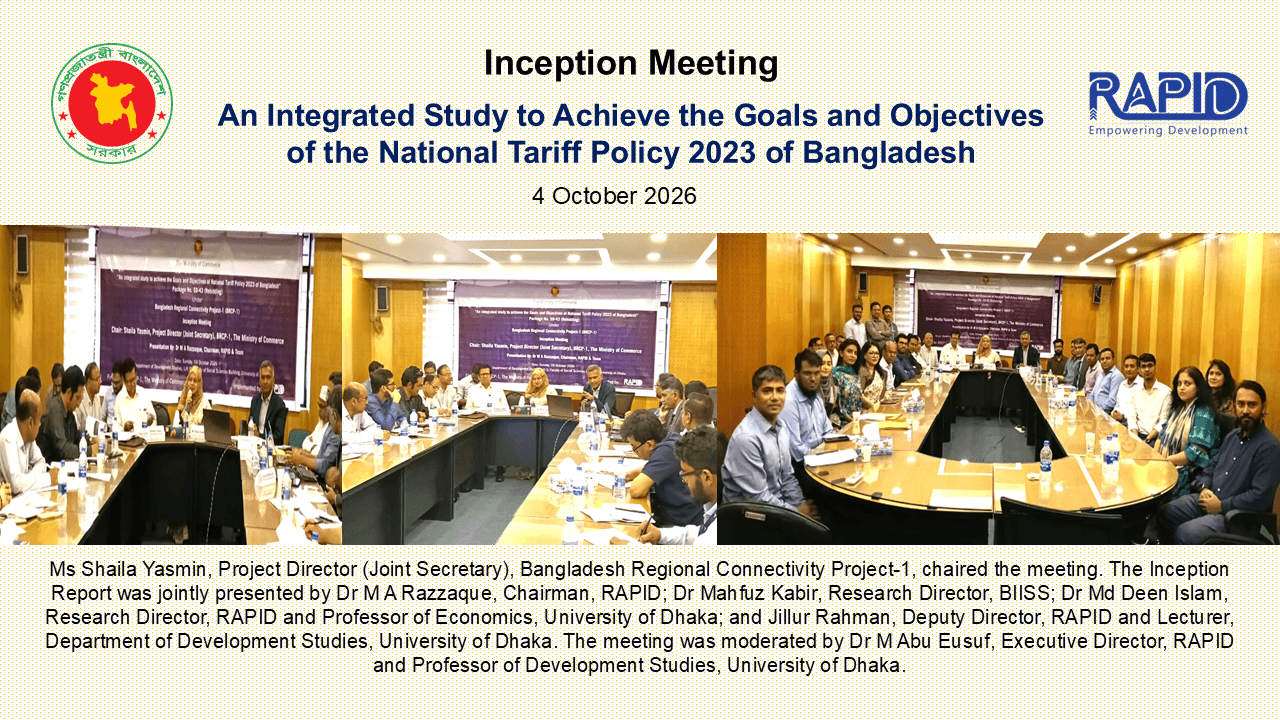
Inception Meeting: An Integrated Study to Achieve the Goals and Objectives of the National Tariff Policy 2023 of Bangladesh
On 4 October 2026, Research and Policy Integration for Development (RAPID), in collaboration with Bangladesh Regional Connectivity Project-1 (BRCP-1), Ministry of Commerce, hosted a Inception Meeting. Ms Shaila Yasmin, Project Director (Joint Secretary), Bangladesh Regional Connectivity Project-1, chaired the meeting. The Inception Report was jointly presented by Dr M A Razzaque, Chairman, RAPID; Dr Mahfuz Kabir, Research Director, BIISS; Dr Md Deen Islam, Research Director, RAPID and Professor of Economics, University of Dhaka; and Jillur Rahman, Deputy Director, RAPID and Lecturer, Department of Development Studies, University of Dhaka. The meeting was moderated by Dr M Abu Eusuf, Executive Director, RAPID and Professor of Development Studies, University of Dhaka.