

Working Paper || March 2026 || Family Card: A path to poverty reduction or new fiscal pressure?

Learning and Professional Growth: Inspired by the Jack Lovell Fellowship
A Conversation with Dr Daniel Gay
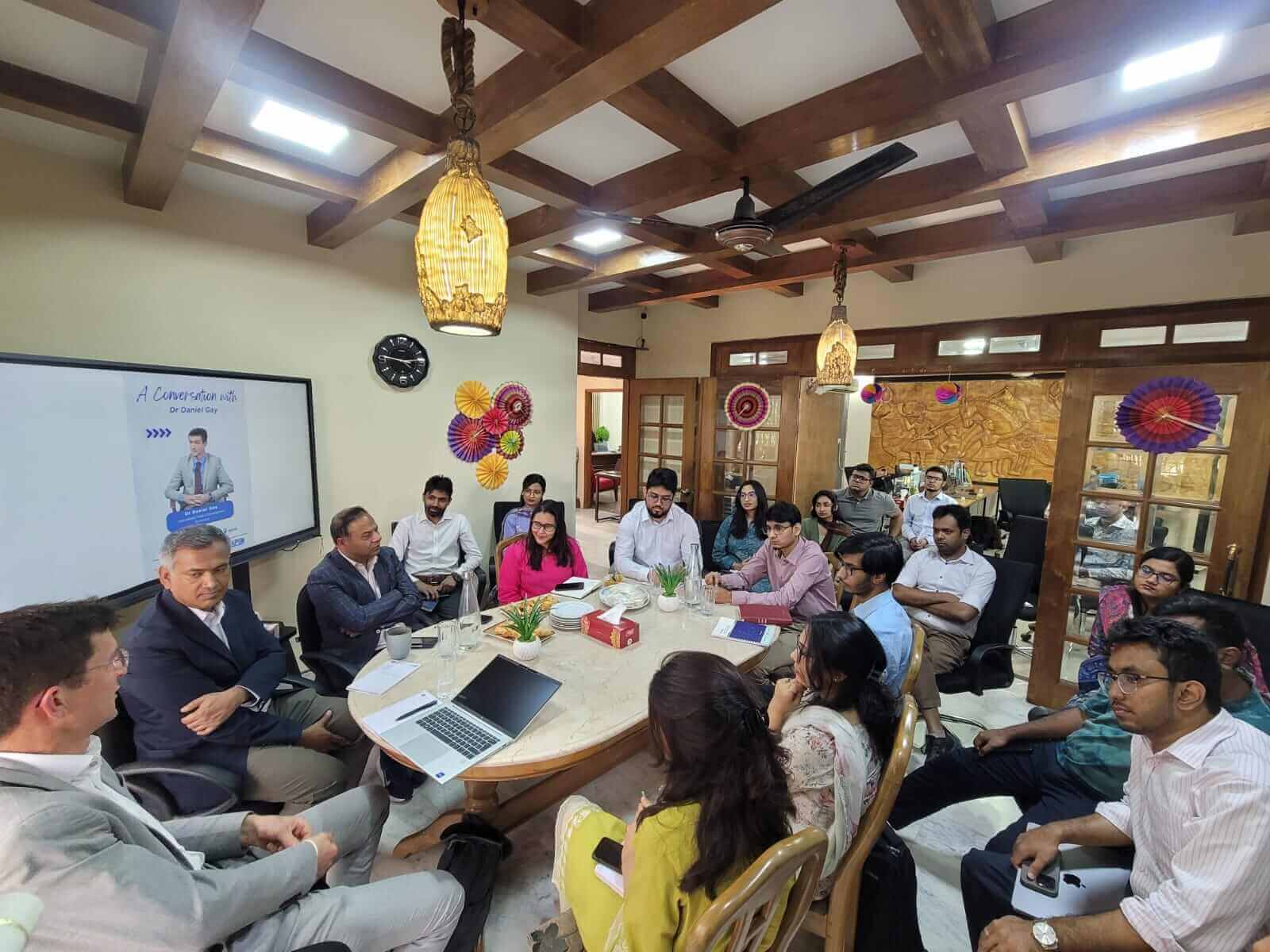
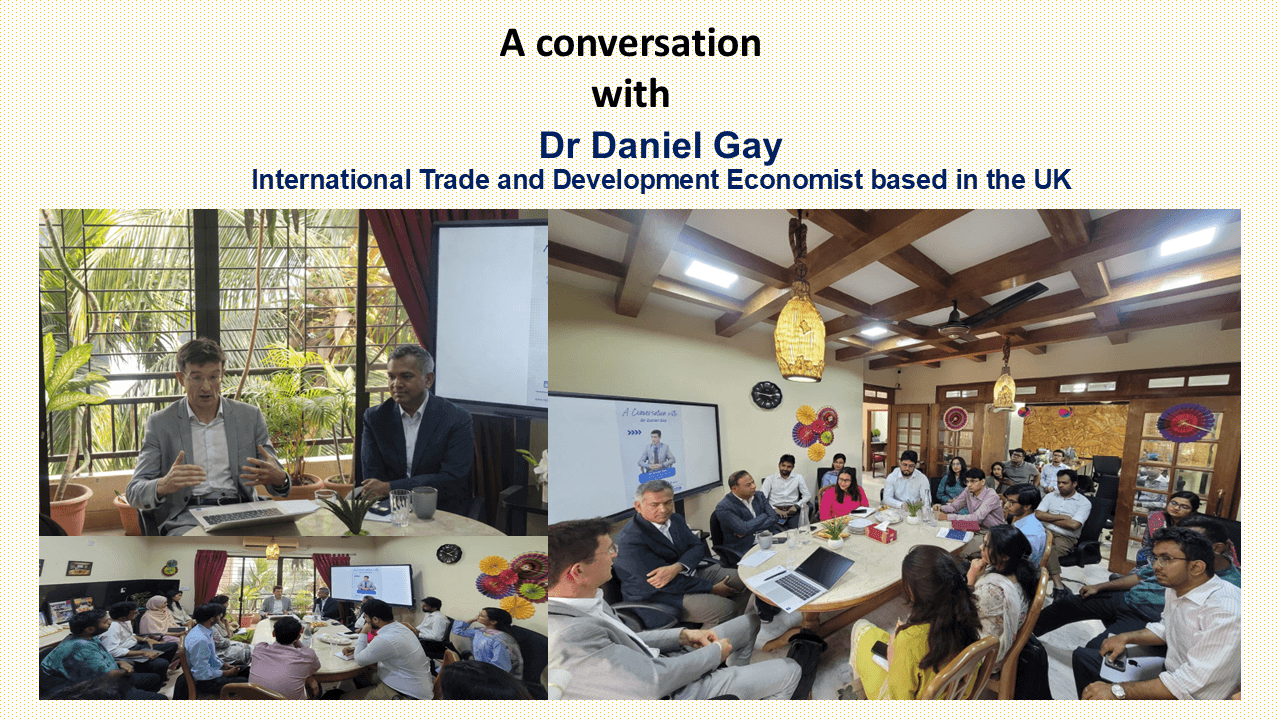
Renowned international trade and development economist, Dr Daniel Gay, visited RAPID on 6 April 2026. He gave an interesting talk on ‘The 'Middle Powers' are Abandoning the World's Least Advantaged Countries on Trade and Development,’ followed by an engaging discussion with RAPID researchers, moderated by RAPID Chairman Dr M A Razzaque. He opened with a thought-provoking reflection that the rules-based international trading order, long sold to the Global South as the path to prosperity, was always partially a lie — and that the middle powers who built and championed it are now quietly walking away, leaving the world's poorest countries to fend for themselves. What followed was a candid, wide-ranging discussion on trade, democracy, and development, the highlights of which are shared in the Q&A segment below.
Rakin Uz Zaman: As you know, the multilateral trading system is completely gone. Do you think it is rational for countries like Bangladesh to spend resources to comply with WTO rules, or should these countries prioritise alternative trade arrangements?
Dr Daniel Gay: I’ve been reflecting on this exact dilemma. As the multilateral trading system reaches this critical crossroads, we have to ask a hard, pragmatic question: Is it still a rational use of Bangladesh’s limited resources to maintain an expensive apparatus in Geneva and exhaust administrative energy on strict WTO compliance?There is an increasing shift toward regional, bilateral, and plurilateral trade arrangements as the effectiveness of the WTO continues to weaken. In this context, strict adherence to WTO rules becomes more complex, particularly when major economies themselves do not consistently comply, raising concerns about fairness and credibility. At the same time, there is a deeper development issue: historically, many countries achieved industrial advancement by imitating foreign technologies, yet current global rules, especially under TRIPS, can constrain that pathway, often with uneven enforcement. While outright non-compliance carries risks, the paralysis of the WTO’s dispute settlement system has reduced the likelihood of enforcement, leaving countries to navigate a more uncertain and fragmented global trading environment with greater strategic flexibility.
Jillur Rahman: Who are the largest beneficiaries of the rules-based trading order, and what is the future of the WTO?
Dr Daniel Gay and Dr M A Razzaque: China is undoubtedly the biggest beneficiary. It joined the WTO, gained access to intellectual property and technology through joint ventures, absorbed that knowledge, and moved on. The US fundamentally miscalculated in thinking it could contain China through the system.The poorest countries were also implicit beneficiaries. Without the WTO, the tariff exploitation we see today could have started in the 1990s. Many developing countries only realise this now that the system is collapsing.
On the WTO’s future, the outlook remains uncertain. Negotiations have progressed slowly in recent years and are increasingly influenced by broader geopolitical dynamics, which can at times constrain progress in technical discussions. While reform proposals may yield incremental improvements, deeper structural challenges persist. One possible trajectory is that the WTO evolves into a more limited administrative role, with a reduced emphasis on its negotiating function.
Ishrat Jahan Ishita: As the world moves away from the WTO/multilateral system towards bilateral negotiations, what strategy should graduating LDC countries like Bangladesh adopt to avoid being exploited by more powerful countries?
Dr Daniel Gay: Multilateralism remains developing countries’ strongest safeguard and should be defended. Bangladesh is especially exposed due to limited trade negotiation capacity and reliance on unilateral preferences. Bilateral deals are risky because power imbalances force concessions that set lasting precedents—even advanced economies like the UK have struggled.The broader challenge is that services trade tends to often receive less policy attention compared to goods trade, partly due to its less visible nature.”This is a pattern seen across countries, not just Bangladesh. Greater public and political awareness is essential to unlocking the sector's potential.
Syful Islam: Under North-South trade, specialisation is clear — LDCs export labour-intensive goods to Europe and America. But under South-South cooperation, how do you define specialisation? For example, Bangladesh vs. India or Bangladesh vs. China?
Dr Daniel Gay: South-South cooperation is not presented as a sole solution, and countries of the Global South cannot cut themselves off from the North. Trade with the North remains essential. Globalisation is also not dead, contrary to popular narratives. It is transforming, shifting more towards services and less towards goods, with services trade growing rapidly across the world.That said, there are slow but steady positive developments in South-South trade. Services trade among Global South countries is expanding, inter-regional trade in East Asia has boomed with China now trading more within the region than with the rest of the world, and the African Continental Free Trade Agreement with 52 members is the largest ever trade agreement among developing countries. However, Africa's collective economy is only the size of France, which underlines that South-South trade alone is insufficient. Access to Northern markets remains critical.
Zara Mustafa: Is trade actually driven by comparative advantage, or is it more political in nature?
Dr Daniel Gay: Comparative advantage is a brilliant analytical tool, but it does not fully explain how trade works in practice. Much of trade is driven by politics. Many modern trade relationships still follow colonial lines due to historical legacy, and powerful countries tend to trade with places that have what they need. China's pursuit of African resources, for instance, is a conscious political decision, not a spontaneous commercial one. Historical examples like the East India Company, European gunboat diplomacy in China, and British resource extraction from Africa were all politically or militarily driven, with no relation to comparative advantage.There is also a large body of economic literature acknowledging that real-world trade deviates significantly from classical theory. As for whether trade can return to being more commercially driven rather than political, it is very difficult to say. The outlook is pessimistic, with things moving in the opposite direction and no clear signs of improvement.
Saraf Wamia: As globalisation shifts into a power-based world, what happens when economic interdependence becomes a tool of coercion? In a multipolar world with a weakening dollar and declining influence of institutions like the World Bank and IMF, what are Bangladesh's development prospects? And if you had to give one or two pieces of advice to Bangladesh's Prime Minister, what would they be?
Dr Daniel Gay: We are in the Asian Century. East Asia's share of global GDP, trade, and FDI continues to rise, and for Bangladesh, regional integration through RCEP, ASEAN, and Asian FTAs represents the clearest future opportunity. South-South solidarity also matters, as collective strength among like-minded countries remains a real source of leverage. The multilateral system, despite its flaws, delivered real gains for developing countries and those gains are still worth defending.On advice for Bangladesh, two priorities stand out. First, the country needs a coherent industrial policy. In a world of rising tariffs and trade frictions, export-led growth faces real obstacles, and Bangladesh's large domestic market of 170 million people offers significant untapped opportunity.
Second, Bangladesh must raise its rate of capital accumulation. Bangladesh continues to face challenges in areas such as tax mobilisation, investment inflows, and savings rates, while remittances present an opportunity that could be further leveraged for productive investment.
Dr M A Razzaque: Given the global trade crisis, should Bangladesh focus more on its domestic market for growth? Or is there hope that after Trump, multilateralism could be revived and trade can still be the engine of growth?
Dr Daniel Gay: We are not going back to normal, even after Trump. The shift began long before him. Global goods trade started stagnating after the 2008 financial crisis, and COVID caused a further collapse. The system was already fracturing, and a revival of multilateralism seems unlikely.That said, trade will continue to evolve, with services becoming increasingly dominant. Bangladesh should not abandon export-driven growth, but must seriously diversify beyond RMG. There is currently an anti-export bias in the economy, as heavy subsidies and protection for the RMG sector inadvertently discourage other export industries from emerging. The right path forward combines policy reforms to diversify exports with a more dynamic domestic industrial policy running alongside.
Nabeeha Sultana: Is development a prerequisite for democracy, or democracy a prerequisite for development? Or are they unrelated, as the case of Singapore suggests?
Dr Daniel Gay: The neoliberal perspective presents free markets, free trade, and democracy as an inevitable package, but this linkage is not universally accepted and there is no clear causal relationship between development and democracy. While democracy may not be a prerequisite for economic growth, it holds intrinsic value as a fundamental human right, allowing individuals a voice in governance. Historical patterns show that many rapidly developing countries were not democratic, suggesting that centralised systems may facilitate capital mobilisation and industrial policy more effectively than dispersed ones. In such contexts, high savings rates and efficient allocation of capital towards productive investment have been key drivers of growth. At the same time, the experience of Northern and Scandinavian Europe demonstrates that democracies are also capable of achieving strong development outcomes, indicating that no single model applies universally.Saraf Wamia: Is majoritarian democracy a thing of the past and post the Brexit referendum there was an argument against asking the common people about policy decisions. What is your take on that?
Dr Daniel Gay: Brexit was not an argument against democracy, but against putting highly complex policy decisions to a single public vote, particularly when public understanding of the issues may be limited. Politicians failed badly at explaining what the EU actually was and what was at stake, and many people simply used it as a protest vote against the ruling class.The core problem is the quality of information. Social media bubbles, disinformation, and asymmetric information all undermine good democratic decision-making. Social media companies should be held responsible for removing dangerous falsehoods and extreme content, and publicly funded independent broadcasting, like the BBC model, remains one proven way to maintain honest information.
Democracy also needs to be redesigned rather than abandoned. More frequent referendums on smaller issues that directly affect people's lives, perhaps via smartphones, could improve participation without the catastrophic risks of something like Brexit. Local democracy matters too, as smaller and more cohesive communities tend to allow for more accountable governance.
Ishrat Jahan Ishita: As global trade moves away from WTO rules, dimming the outlook for commodity exports, what opportunities does Bangladesh have in services trade, and how can it capitalise on them?
Dr Daniel Gay: Global services trade—especially digitally deliverable services—has grown rapidly, likely beyond what statistics capture, with strong acceleration since COVID. Its key advantage is market access from anywhere without physical relocation. Bangladesh has yet to fully capitalise on this.What is needed is a shift in skills and training towards practical, marketable digital services. Alongside this, existing barriers around payments, certification, licensing, and compliance with target market standards must be addressed. Most importantly, services trade needs to become a core government policy priority rather than an afterthought. Evidence already points to strong potential here. A recent project surveying UK firms found significant scope to outsource IT and other services to Bangladesh at competitive cost.
The broader challenge is that services trade tends to be overlooked by politicians because it is intangible and invisible, unlike physical goods. This is a pattern seen across countries, not just Bangladesh. Greater public and political awareness is essential to unlocking the sector's potential.